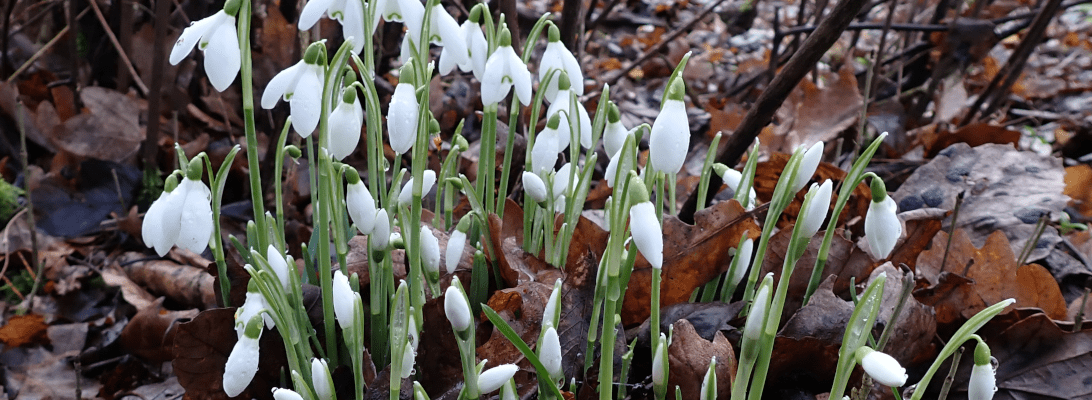
The snowdrop is one of the first flowers to bloom, brightening the gloom of a February walk.
As wintery conditions are possible at this time of year, a protective sheath covering the tip of the flowering stem enables the flower to force its way up through the snow. But alternatively, should a warm spell occur, then these flowers provide an early feast for honeybees and early queen bees, who, in turn, pollinate the flowers.
Due to the uncertainty of the weather, snowdrops don’t rely on pollinators to reproduce as they spread mainly through bulb division.
Snowdrops have six white flower segments known as tepals arranged in two whorls. They are referred to as tepals, as there is a lack of distinction between sepals and petals.
The inner three tepals are smaller and have a notch in the tip with a green spot.
Flowering early in spring before the leaves on the trees emerge, casting the woodland into shade allows snowdrops to use the available light to grow, flower, and reproduce.
Although the bulbs are poisonous to eat, a naturally occurring compound in snowdrops called galantamine is now in use to treat the symptoms of Alzheimer’s disease.
I am attempting to keep a note of when plants come into flower and will post photographs and information in the wildflower diary project
 Incredibly Wild East Kilbride