If asked to describe the colours of winter, I would come up with drab greys and browns, which are not very inspiring.
However, I have noticed on recent walks that these drab tones are merely the backdrop for more vivid colours to pop.
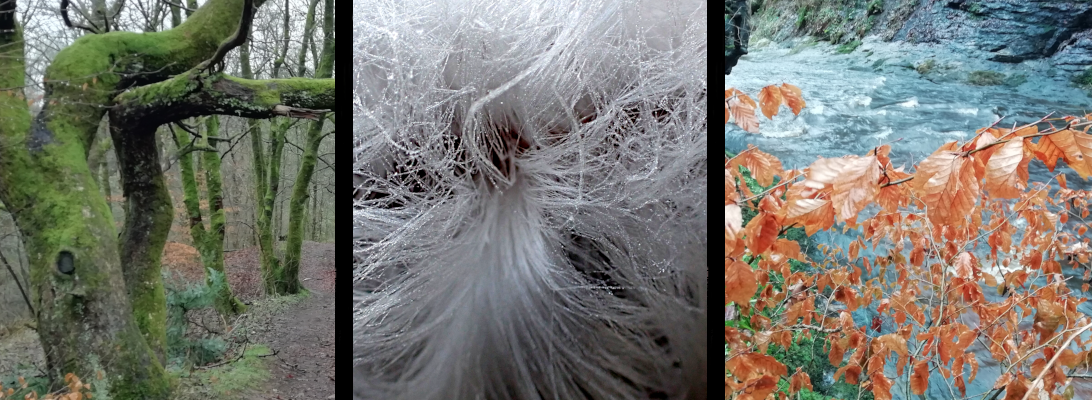
The first colour to pop was the velvety green cloaking the trees.
Not a colour you associate with trees in winter.
Green is the colour you notice in spring as fresh new leaves burst out their buds.
Yet here we are in the middle of winter, and I see green trees.
At this time of year, it is not leafy green but instead mossy green.
But is it just mossy green?
On closer examination, different lichens and ferns also play their part in brightening a winter’s walk through the woods.
The next colour to pop was icy white, in the form of white clumps forming on the dead branches of trees scattered on the woodland floor.
Closer examination revealed delicate strands of ice forming beautiful intricate patterns, a phenomenon known as hair ice.
For this to occur, the conditions required are specific.
Rotting wood from broad-leaved trees in a moist atmosphere where the temperature is below freezing enables water to push out of the pores. Then if a specific fungus is present, stable strands of ice will form that can create beautiful formations.
If you are interested in a more detailed description, it is worth visiting the Met Office website for more information.
Finally, the vivid copper tones of the leaves from young beech trees go well with the velvety green of the moss, and when viewed next to the river, they stand out.
Beech trees, particularly young ones, hang onto their withered leaves during winter.
They are not the only trees to do this, as oaks also do it as part of a phenomenon called marcesence.
There appear to be different explanations as to why trees do this.
One explanation is that it could be to protect leaf buds as they form during winter, another is that it provides a source of nutrients for the tree when they eventually fall off.
Whatever the reason, the vivid copper of the beech and the velvety green of the moss, together with the icy white of hair ice when it is around, all brighten up what could be a drab walk in winter.
 Incredibly Wild East Kilbride