Snowdrops Brightening up a gloomy February Walk

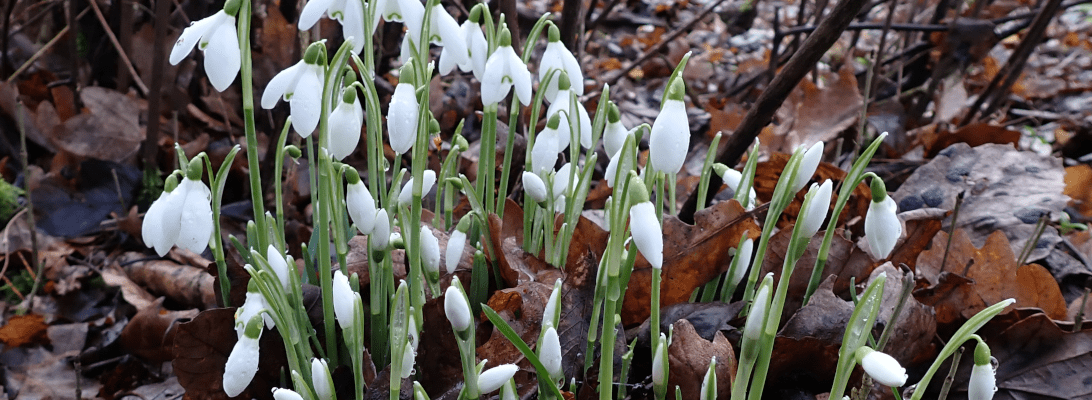
a clump of snowdrops

The snowdrop is one of the first flowers to bloom, brightening the gloom of a February walk.

As wintery conditions are possible at this time of year, a protective sheath covering the tip of the flowering stem enables the flower to force its way up through the snow. But alternatively, should a warm spell occur, then these flowers provide an early feast for honeybees and early queen bees, who, in turn, pollinate the flowers.

Due to the uncertainty of the weather, snowdrops don’t rely on pollinators to reproduce as they spread mainly through bulb division.

Snowdrops have six white flower segments known as tepals arranged in two whorls. They are referred to as tepals, as there is a lack of distinction between sepals and petals.

The inner three tepals are smaller and have a notch in the tip with a green spot.

Flowering early in spring before the leaves on the trees emerge, casting the woodland into shade allows snowdrops to use the available light to grow, flower, and reproduce.

Although the bulbs are poisonous to eat, a naturally occurring compound in snowdrops called galantamine is now in use to treat the symptoms of Alzheimer’s disease.

I am attempting to keep a note of when plants come into flower and will post photographs and information in the wildflower diary project
A splash of Colour on A Dreich Day

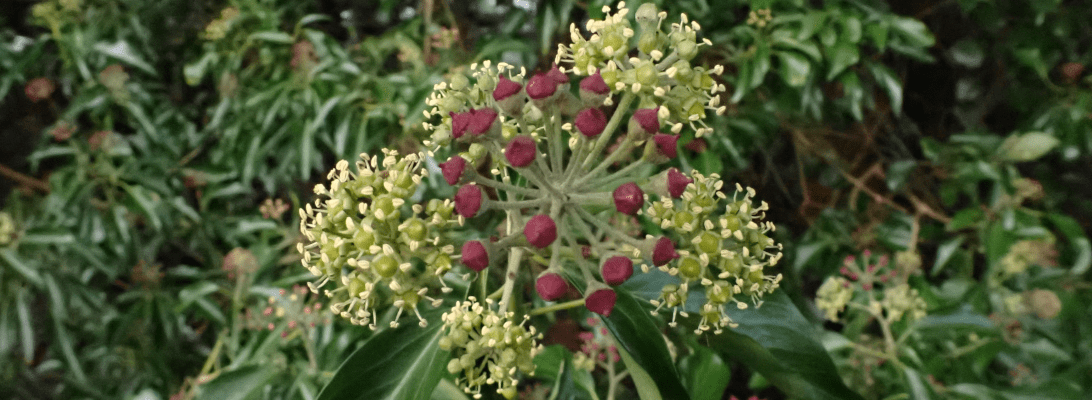
five flowerheads of ivy in bloom and another central cluster yet to bloom

Flowering Ivy is a splash of color on a dreich day.

Its smooth dark shiny green leaves have three to five lobes except where there are flowers. Flowers will only appear on mature growth. Look closely, and you will notice the leaves are a different shape. They are more of a diamond shape.

In late autumn, being one of the last plants to flower, Ivy produces clusters of greenish-yellow flowers that develop into black berries in winter.

Taking advantage of the spaces created by people, it grows well in gardens, at the edges of woodland, and through hedgerows.

Yet this woody climber that clambers its way over trees, walls, and across the ground is much maligned.
The reason for this is too many, Ivy is a killer of trees, but unlike mistletoe, it has no parasitic tendencies.

Although Ivy plants have stem rootlets, they are purely for support to allow them to climb trees. They do not need to take water and nutrients from their host, having their own independent root system. On the other hand, mistletoe has no roots requiring it to take in water and nutrients from its host plant. To be accurate, because this plant is evergreen, it can make sugar all year round and is more accurately hemiparasitic.

Only when a host tree can no longer support the weight of Ivy can it be considered a problem. In these circumstances, trees are indeed at risk of toppling over. Usually, this only occurs when trees are already old or damaged. If kept in check, then Ivy need not be a problem.

Rather than malign this plant, I would argue that Ivy is a plant that should be valued. It not only provides color in the dull month of November but throughout the year, it has enormous value for wildlife.

The flowers are an essential source of pollen and nectar for many insects, including honey bees, social wasps, and even butterflies like the red admiral.

Later in the year, the berries provide a welcome food source for thrushes such as blackbirds.

As well as being a food source, it offers places for insects to overwinter and shelter and nesting places for many small birds.

Therefore let’s celebrate Ivy.

Overlooked

Local orchids are often attractive with their pretty bright pinks, purples, and even yellows.
But here are two orchids that are not bright and arguably not particularly attractive, making it easy to overlook them.
One is the Broad Leaved Helleborine, a drab-looking plant, mainly green, producing small dark pink/purple flowers.
If you look for it, you can find it in many different places, such as woodlands, hedgerows, and roadsides.
Once you spot it for the first time, you will keep seeing it.
It is now so common around Glasgow that it is called the Glasgow Orchid.
Another drab-looking orchid is the Bird’s Nest Orchid.
The name comes from the tangle of roots that are supposed to resemble a bird’s nest. These roots are necessary, as, unlike most plants, there is no green in the plant’s foliage, so no chlorophyll is present to enable it to make sugars. Instead, it relies on the presence of a particular fungus in the soil for its nutrients. This fungus, in turn, attaches itself to trees such as beech for its nutrients.
Specimens did occur on the South Trail, Calderglen Country Park in East Kilbride. Sadly these have not been seen for some time.
The illustrated specimen above was seen recently in dense woodland in the Calderwood area within the north end of Calderglen Country Park.
Its preference for dense shade and specific growing conditions make the Birds nest Orchid hard to spot, so unlike the Broad Leaved Helleborine, it is rarely seen. Therefore few records exist, suggesting it is rare, but could that be due to under-recording?
So while out exploring, be aware of what you can easily overlook.