Velvety Green, Icy White and Vivid Copper 

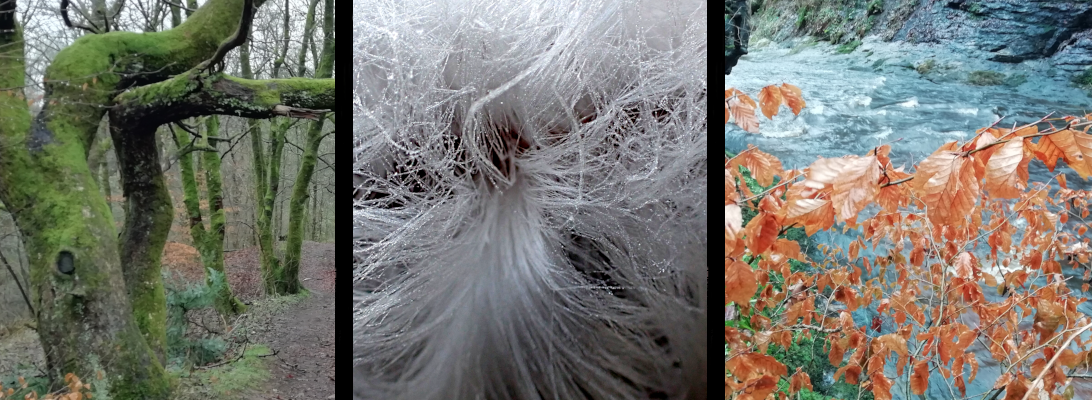
Three images of the different colours of winter. Mossy green on trees, white hair ice in a rosette pattern and copper beech leaves against the slate grey of water.

If asked to describe the colours of winter, I would come up with drab greys and browns, which are not very inspiring.
However, I have noticed on recent walks that these drab tones are merely the backdrop for more vivid colours to pop.

The first colour to pop was the velvety green cloaking the trees.
Not a colour you associate with trees in winter.
Green is the colour you notice in spring as fresh new leaves burst out their buds.
Yet here we are in the middle of winter, and I see green trees.
At this time of year, it is not leafy green but instead mossy green.
But is it just mossy green?
On closer examination, different lichens and ferns also play their part in brightening a winter’s walk through the woods.

The next colour to pop was icy white, in the form of white clumps forming on the dead branches of trees scattered on the woodland floor.
Closer examination revealed delicate strands of ice forming beautiful intricate patterns, a phenomenon known as hair ice.

For this to occur, the conditions required are specific.
Rotting wood from broad-leaved trees in a moist atmosphere where the temperature is below freezing enables water to push out of the pores. Then if a specific fungus is present, stable strands of ice will form that can create beautiful formations.
If you are interested in a more detailed description, it is worth visiting the Met Office website for more information.

Finally, the vivid copper tones of the leaves from young beech trees go well with the velvety green of the moss, and when viewed next to the river, they stand out.
Beech trees, particularly young ones, hang onto their withered leaves during winter.
They are not the only trees to do this, as oaks also do it as part of a phenomenon called marcesence.
There appear to be different explanations as to why trees do this.
One explanation is that it could be to protect leaf buds as they form during winter, another is that it provides a source of nutrients for the tree when they eventually fall off.

Whatever the reason, the vivid copper of the beech and the velvety green of the moss, together with the icy white of hair ice when it is around, all brighten up what could be a drab walk in winter.

A splash of Colour on A Dreich Day

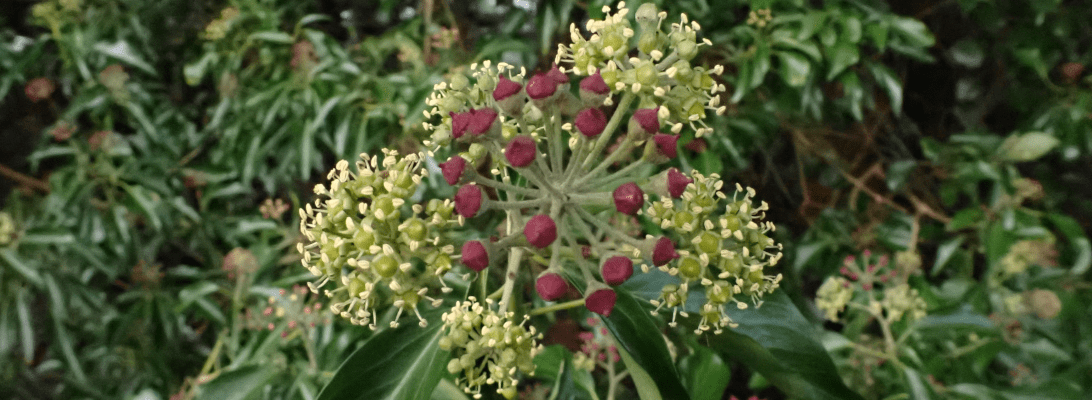
five flowerheads of ivy in bloom and another central cluster yet to bloom

Flowering Ivy is a splash of color on a dreich day.

Its smooth dark shiny green leaves have three to five lobes except where there are flowers. Flowers will only appear on mature growth. Look closely, and you will notice the leaves are a different shape. They are more of a diamond shape.

In late autumn, being one of the last plants to flower, Ivy produces clusters of greenish-yellow flowers that develop into black berries in winter.

Taking advantage of the spaces created by people, it grows well in gardens, at the edges of woodland, and through hedgerows.

Yet this woody climber that clambers its way over trees, walls, and across the ground is much maligned.
The reason for this is too many, Ivy is a killer of trees, but unlike mistletoe, it has no parasitic tendencies.

Although Ivy plants have stem rootlets, they are purely for support to allow them to climb trees. They do not need to take water and nutrients from their host, having their own independent root system. On the other hand, mistletoe has no roots requiring it to take in water and nutrients from its host plant. To be accurate, because this plant is evergreen, it can make sugar all year round and is more accurately hemiparasitic.

Only when a host tree can no longer support the weight of Ivy can it be considered a problem. In these circumstances, trees are indeed at risk of toppling over. Usually, this only occurs when trees are already old or damaged. If kept in check, then Ivy need not be a problem.

Rather than malign this plant, I would argue that Ivy is a plant that should be valued. It not only provides color in the dull month of November but throughout the year, it has enormous value for wildlife.

The flowers are an essential source of pollen and nectar for many insects, including honey bees, social wasps, and even butterflies like the red admiral.

Later in the year, the berries provide a welcome food source for thrushes such as blackbirds.

As well as being a food source, it offers places for insects to overwinter and shelter and nesting places for many small birds.

Therefore let’s celebrate Ivy.