Wildlife Highlights of 2022

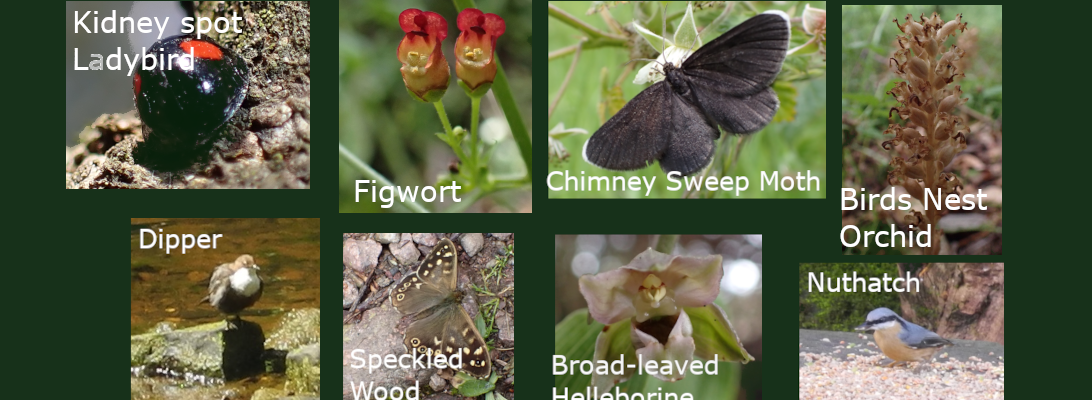
A graphic showing a Kidney spot ladybird, figwort, chimneysweep moth, bird's nest orchid, a dipper, a speckled wood Butterfly, a nuthatch bird, and a Broad Leaved Helleborine.

It has been an interesting year for wildlife spotting, from tiny ladybirds to ugly flowers. Here are some highlights local to East Kilbride:

Chimney Sweep Moth

This moth is unusual as it flies during the day. I initially thought it was a butterfly. However, on closer examination, the antennae were not shaped like clubs, as you would expect with butterflies. I have often seen them in other places, but this was the first time I had seen one in Calderwood amongst pignut.

Bird’s Nest Orchid

I was walking through dense woodland and nearly stepped on one of a cluster of about twelve plants. These plants lack the green pigment Chlorophyll, which is why they are brown in color, making them perfectly camouflaged against the beech leaves that I happened to be walking through at the time of my discovery. Their name comes from the tangle of a root-like system that is said to resemble a bird’s nest. They get their nutrition from being a parasite on other plants, such as trees.

Speckled Wood Butterfly

This butterfly flies along sunny woodland rides. Its range has been expanding north. I saw this butterfly for the first time in the woods around Dumfries, but I have heard that there have been sightings locally. I saw a report of a sighting in K-woodlands near Hairmyres, which is fantastic. So next year, the aim is to try and spot it locally.

Figwort

The plant I found was probably the common figwort, and just like the Bird’s Nest Orchid, it is also quite ugly. It was extremely tall and had a distinctively square stem.
This year was the first time I had seen it on the main nature trail heading north in the Calderglen Gorge Woodland near the Black Linn Waterfall.

Kidney Spot Ladybird

A tiny ladybird that had it not been for another visitor to Cathkin Marsh, I would have walked by and never would have known it was there. This ladybird is only about 4-5mm in length, with two distinct red spots, one on each wing case. If you look carefully, there is a distinctive rim around the wing cases. If I remember correctly, it, along with several others, was on Willow (Salix spp).

Broad-Leaved Helleborine

This flower is not the prettiest of orchids, but for me, this was the first year that I had spotted it in East Kilbride along path edges. It flowers from July to September and likes disturbed places, particularly around the Glasgow area, and because of this, it has become known as the Glasgow Orchid.

Dipper

This incredible little bird can hunt underwater, and a day by the Rotten Calder River is not complete without seeing a Dipper. In previous years, I was worried that numbers were dwindling. They probably still are, but at least this year, I had more sightings than I have in previous years, and I also saw had sightings below Newhousemill Bridge and even below Castle Falls. So that is hopeful.

Nuthatch

It was once the case that this bird was resident mainly in England, but in recent years it has spread north. I saw it for the first time last year, and now it is visiting the garden. It is an incredibly agile little bird with the ability to descend head first down the trunk of trees.

Overlooked

Local orchids are often attractive with their pretty bright pinks, purples, and even yellows.
But here are two orchids that are not bright and arguably not particularly attractive, making it easy to overlook them.
One is the Broad Leaved Helleborine, a drab-looking plant, mainly green, producing small dark pink/purple flowers.
If you look for it, you can find it in many different places, such as woodlands, hedgerows, and roadsides.
Once you spot it for the first time, you will keep seeing it.
It is now so common around Glasgow that it is called the Glasgow Orchid.
Another drab-looking orchid is the Bird’s Nest Orchid.
The name comes from the tangle of roots that are supposed to resemble a bird’s nest. These roots are necessary, as, unlike most plants, there is no green in the plant’s foliage, so no chlorophyll is present to enable it to make sugars. Instead, it relies on the presence of a particular fungus in the soil for its nutrients. This fungus, in turn, attaches itself to trees such as beech for its nutrients.
Specimens did occur on the South Trail, Calderglen Country Park in East Kilbride. Sadly these have not been seen for some time.
The illustrated specimen above was seen recently in dense woodland in the Calderwood area within the north end of Calderglen Country Park.
Its preference for dense shade and specific growing conditions make the Birds nest Orchid hard to spot, so unlike the Broad Leaved Helleborine, it is rarely seen. Therefore few records exist, suggesting it is rare, but could that be due to under-recording?
So while out exploring, be aware of what you can easily overlook.

A Butterfly of Hope

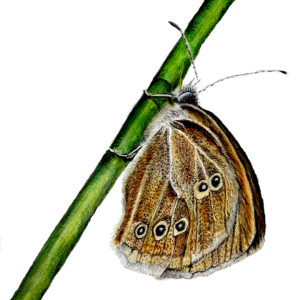
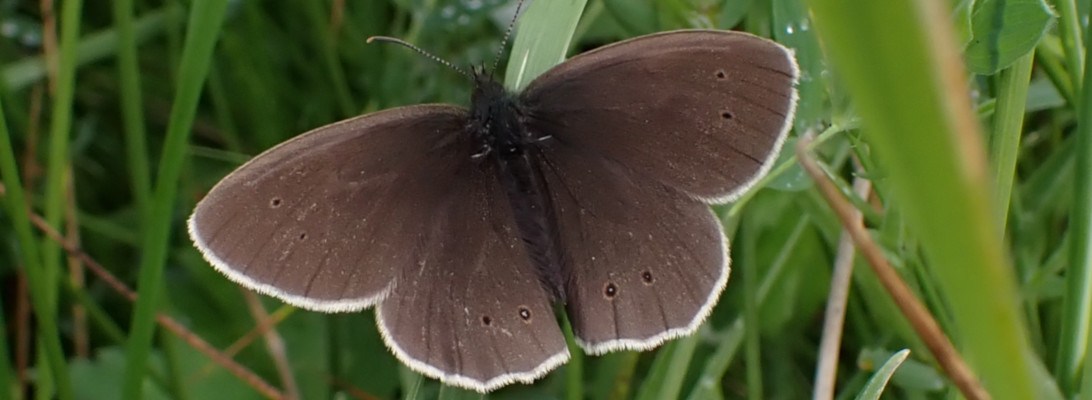
A brown ringlet butterfly

Hope in the form of a butterfly.

During the summer, I often see this little chocolate brown butterfly fluttering over tall, lush damp grassland, even in wet weather. 

The distinctive rings that are on the wings are what give it the descriptive name, the ringlet

These butterflies are quite common, but this was not always the case. 

Until relatively recently, it was a butterfly that I had rarely seen.

 My first sighting, I remember, was while out walking at Ardochrig just above Auldhouse near East Kilbride. 

Having read the recently published book, Discovering Scotland’s Butterflies by Paul Kirkland, it appears that during the 1970s, this butterfly was spreading north, reclaiming territory. 

According to the book, records from the 19th Century show that it was present South of a line from Skye to the Lothians. 

It then describes how in the 20th Century, a decline had set in, suggesting that air pollution may have been the cause. 

Now during the summer, while walking amongst the tall grass, I see it almost every time. 

The growth in coarse grasses such as Cocks foot and Tufted Hair grass will have aided its ability to reclaim former territory, but so will climate change. 

Milder winters will also make it easier for caterpillars to overwinter.

It is easy to get disillusioned by what often appears to be a constant stream of bad news stories, but the change in this little butterfly’s fortune gives me hope.