Velvety Green, Icy White and Vivid Copper 

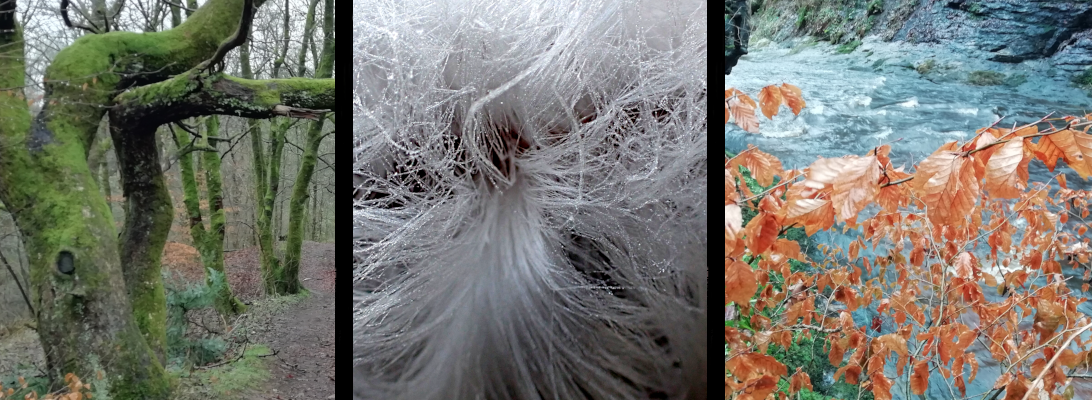
Three images of the different colours of winter. Mossy green on trees, white hair ice in a rosette pattern and copper beech leaves against the slate grey of water.

If asked to describe the colours of winter, I would come up with drab greys and browns, which are not very inspiring.
However, I have noticed on recent walks that these drab tones are merely the backdrop for more vivid colours to pop.

The first colour to pop was the velvety green cloaking the trees.
Not a colour you associate with trees in winter.
Green is the colour you notice in spring as fresh new leaves burst out their buds.
Yet here we are in the middle of winter, and I see green trees.
At this time of year, it is not leafy green but instead mossy green.
But is it just mossy green?
On closer examination, different lichens and ferns also play their part in brightening a winter’s walk through the woods.

The next colour to pop was icy white, in the form of white clumps forming on the dead branches of trees scattered on the woodland floor.
Closer examination revealed delicate strands of ice forming beautiful intricate patterns, a phenomenon known as hair ice.

For this to occur, the conditions required are specific.
Rotting wood from broad-leaved trees in a moist atmosphere where the temperature is below freezing enables water to push out of the pores. Then if a specific fungus is present, stable strands of ice will form that can create beautiful formations.
If you are interested in a more detailed description, it is worth visiting the Met Office website for more information.

Finally, the vivid copper tones of the leaves from young beech trees go well with the velvety green of the moss, and when viewed next to the river, they stand out.
Beech trees, particularly young ones, hang onto their withered leaves during winter.
They are not the only trees to do this, as oaks also do it as part of a phenomenon called marcesence.
There appear to be different explanations as to why trees do this.
One explanation is that it could be to protect leaf buds as they form during winter, another is that it provides a source of nutrients for the tree when they eventually fall off.

Whatever the reason, the vivid copper of the beech and the velvety green of the moss, together with the icy white of hair ice when it is around, all brighten up what could be a drab walk in winter.
Wildlife Highlights of 2022

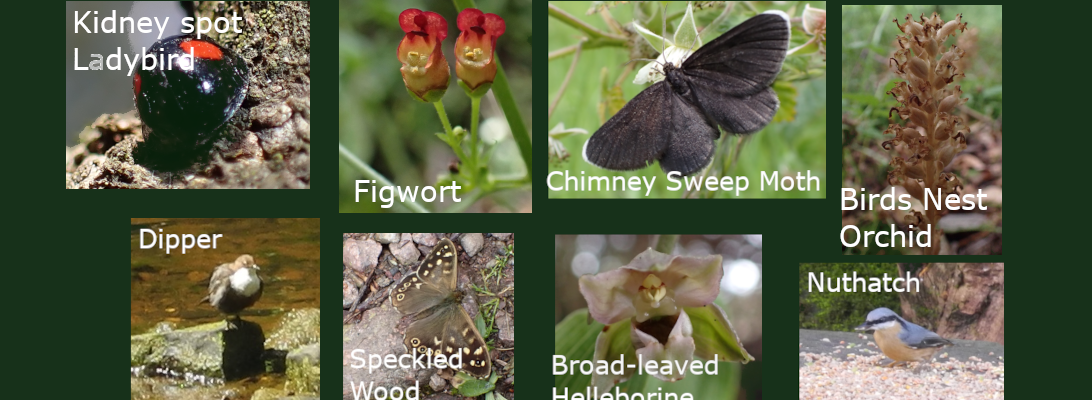
A graphic showing a Kidney spot ladybird, figwort, chimneysweep moth, bird's nest orchid, a dipper, a speckled wood Butterfly, a nuthatch bird, and a Broad Leaved Helleborine.

It has been an interesting year for wildlife spotting, from tiny ladybirds to ugly flowers. Here are some highlights local to East Kilbride:

Chimney Sweep Moth

This moth is unusual as it flies during the day. I initially thought it was a butterfly. However, on closer examination, the antennae were not shaped like clubs, as you would expect with butterflies. I have often seen them in other places, but this was the first time I had seen one in Calderwood amongst pignut.

Bird’s Nest Orchid

I was walking through dense woodland and nearly stepped on one of a cluster of about twelve plants. These plants lack the green pigment Chlorophyll, which is why they are brown in color, making them perfectly camouflaged against the beech leaves that I happened to be walking through at the time of my discovery. Their name comes from the tangle of a root-like system that is said to resemble a bird’s nest. They get their nutrition from being a parasite on other plants, such as trees.

Speckled Wood Butterfly

This butterfly flies along sunny woodland rides. Its range has been expanding north. I saw this butterfly for the first time in the woods around Dumfries, but I have heard that there have been sightings locally. I saw a report of a sighting in K-woodlands near Hairmyres, which is fantastic. So next year, the aim is to try and spot it locally.

Figwort

The plant I found was probably the common figwort, and just like the Bird’s Nest Orchid, it is also quite ugly. It was extremely tall and had a distinctively square stem.
This year was the first time I had seen it on the main nature trail heading north in the Calderglen Gorge Woodland near the Black Linn Waterfall.

Kidney Spot Ladybird

A tiny ladybird that had it not been for another visitor to Cathkin Marsh, I would have walked by and never would have known it was there. This ladybird is only about 4-5mm in length, with two distinct red spots, one on each wing case. If you look carefully, there is a distinctive rim around the wing cases. If I remember correctly, it, along with several others, was on Willow (Salix spp).

Broad-Leaved Helleborine

This flower is not the prettiest of orchids, but for me, this was the first year that I had spotted it in East Kilbride along path edges. It flowers from July to September and likes disturbed places, particularly around the Glasgow area, and because of this, it has become known as the Glasgow Orchid.

Dipper

This incredible little bird can hunt underwater, and a day by the Rotten Calder River is not complete without seeing a Dipper. In previous years, I was worried that numbers were dwindling. They probably still are, but at least this year, I had more sightings than I have in previous years, and I also saw had sightings below Newhousemill Bridge and even below Castle Falls. So that is hopeful.

Nuthatch

It was once the case that this bird was resident mainly in England, but in recent years it has spread north. I saw it for the first time last year, and now it is visiting the garden. It is an incredibly agile little bird with the ability to descend head first down the trunk of trees.

The National Tree of Chile Growing in Scotland

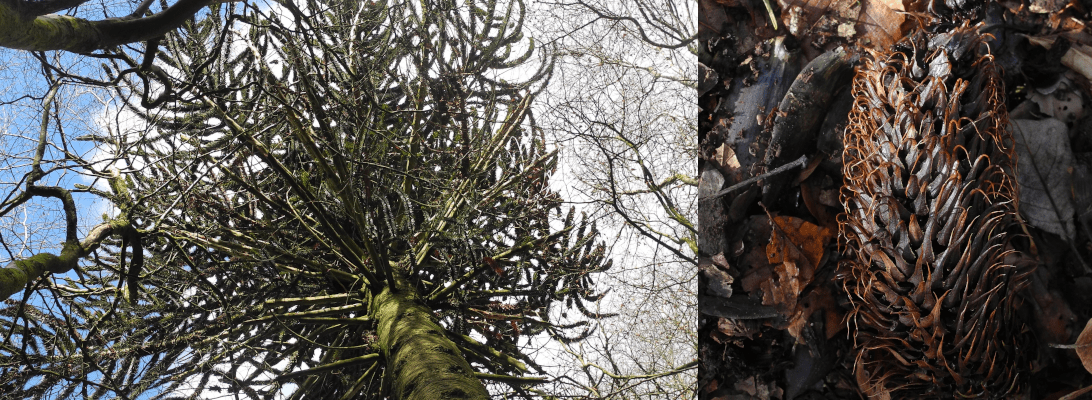
The Monkey Puzzle tree pictured is growing in Calderwood, East Kilbride. 

When in the company of others, I always point it out as it is such an impressive tree towering high with its thick prickly branches and wrinkly bark. It is a tree that can live a long time. This characteristic, combined with its distinctive look, has led many to describe it as a living fossil. 

I knew the tree had initially been brought over to this country from South America by the Scottish Plant Hunter Archibald Menzies. At the time, it was one of several introduced trees, highly prized for their ornamental value.

More recently, I read that it was becoming endangered in its native homeland due to pressures from logging, forest fires, and overgrazing of seedling trees, a situation that is sadly facing many of the world’s trees. 

Interestingly, Monkey Puzzles grow well in Scotland because the climate is similar to the areas in South America where it grows. 

With this being the case, collaboration has occurred between South America and Scotland to try and help reverse the decline in Monkey Puzzle Trees back in its homeland. 

The trees growing in Scotland are helping to diversify the genetic stock back in South America.

This return of trees to their native land to assist with conservation efforts is interesting, so it is a story I usually share with groups when we pass by the tree. 

On one of these walks, there was a lady from Chile present who on our first walk did not initially recognize the name Monkey Puzzle or the tree.

However, after discussing it further on a subsequent walk, we realized its significance.

The tree is better known in her home country as a Chilean Pine, Araucaria araucana, and is the national tree of Chile. It is native to central and southern Chile and western Argentina. 

When it first arrived in the UK, the scale-like leaves with their razor-sharp edges would be, it was said, a puzzle even for monkeys to climb. So that was how it became known in this country as the Monkey Puzzle tree. 

It continues to be popular, with many people choosing it for its ornamental value. 

I first read the story about Scottish efforts to assist in the conservation of the Chilean Pine in the book, A Handbook of Scotland’s Trees, edited by Fi Martynoga for the organisation, Reforesting Scotland.

For further information, visit the link Endangered monkey puzzles planted in Perthshire | Perth and Kinross Countryside Trust (pkct.org)    

A splash of Colour on A Dreich Day

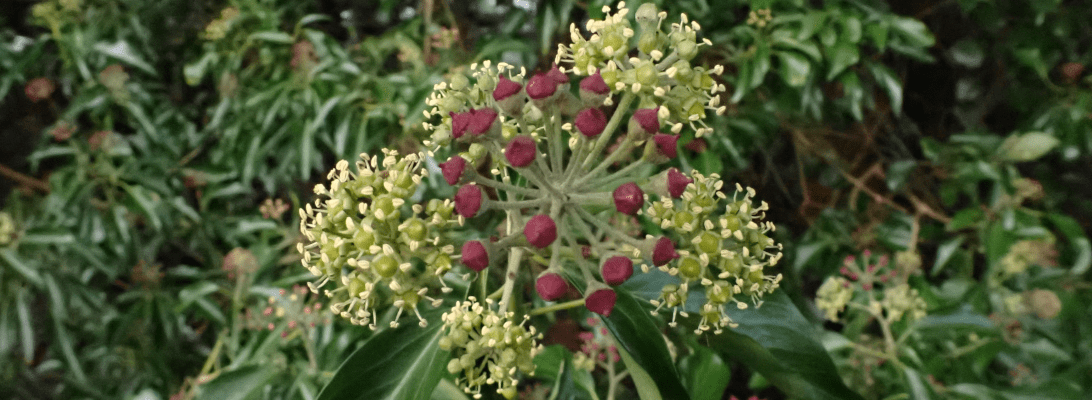
five flowerheads of ivy in bloom and another central cluster yet to bloom

Flowering Ivy is a splash of color on a dreich day.

Its smooth dark shiny green leaves have three to five lobes except where there are flowers. Flowers will only appear on mature growth. Look closely, and you will notice the leaves are a different shape. They are more of a diamond shape.

In late autumn, being one of the last plants to flower, Ivy produces clusters of greenish-yellow flowers that develop into black berries in winter.

Taking advantage of the spaces created by people, it grows well in gardens, at the edges of woodland, and through hedgerows.

Yet this woody climber that clambers its way over trees, walls, and across the ground is much maligned.
The reason for this is too many, Ivy is a killer of trees, but unlike mistletoe, it has no parasitic tendencies.

Although Ivy plants have stem rootlets, they are purely for support to allow them to climb trees. They do not need to take water and nutrients from their host, having their own independent root system. On the other hand, mistletoe has no roots requiring it to take in water and nutrients from its host plant. To be accurate, because this plant is evergreen, it can make sugar all year round and is more accurately hemiparasitic.

Only when a host tree can no longer support the weight of Ivy can it be considered a problem. In these circumstances, trees are indeed at risk of toppling over. Usually, this only occurs when trees are already old or damaged. If kept in check, then Ivy need not be a problem.

Rather than malign this plant, I would argue that Ivy is a plant that should be valued. It not only provides color in the dull month of November but throughout the year, it has enormous value for wildlife.

The flowers are an essential source of pollen and nectar for many insects, including honey bees, social wasps, and even butterflies like the red admiral.

Later in the year, the berries provide a welcome food source for thrushes such as blackbirds.

As well as being a food source, it offers places for insects to overwinter and shelter and nesting places for many small birds.

Therefore let’s celebrate Ivy.

Fairy Rings

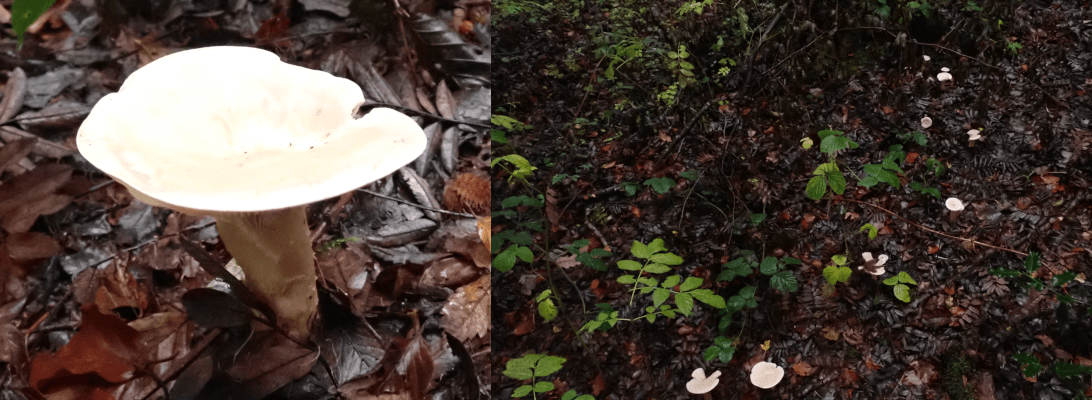
An image showing a partial ring of mushrooms around a tree and a close-up of one of the mushrooms within the fairy ring.

This year has been a good year for finding fungi.

I have been intrigued by the number of times I have discovered almost complete circles of fungi around trees, often called Fairy Rings.

Unfortunately, I do not know their names.

Having taken photographs of these, I do intend to try and identify them.

The mushrooms seen at this time of year are the fruiting bodies.

These contain spores that help the mushrooms reproduce and disperse.

The mushroom or fruiting body is only part of the fungi.

Hidden from view are individual strands called hyphae, which come together to form a network called mycelium.

These threads have a similar function to the roots of a tree, extending out and absorbing minerals.

The one drawback for fungi is that they cannot make sugar. For that, they rely on forming mutualistic relationships with plants. The fungi benefit from the plants that give them carbon-rich nutrients. In return, they offer the plants mineral nutrients from the soil.

For this exchange to happen, fungal threads have to bore into the roots of the trees, creating what is known as a mycorrhizal network.

These mycorrhizal networks are complex, and it is only in recent times ecologist Suzzane Simard demonstrated this complexity. She established that trees not only benefit from the exchange of nutrients but can also communicate their needs.

At the time of her work, the world wide web allowing people to communicate through the internet was establishing itself. So to describe the communication network between trees, the Wood Wide Web was coined.

If you get the chance, read the book by Suzzane Simard, Finding the Mother Tree. It is a fabulous read.

The Rusty Coloured Violent Water

The Rotten Calder Water in South Lanarkshire, Scotland, is a river that starts its journey as the Calder Water up in the Ardochrig hills above the village of Auldhouse before passing East Kilbride and Blantyre.

It continues until it meets up with the Rotten Burn, where it becomes known as the Rotten Calder Water.

The term “Water” in this context suggests bigger than a burn but not as large as a river, like the River Clyde into which the Rotten Calder eventually flows.

The Rotten Calder is a lovely river to walk beside, but its name would suggest otherwise. Rotten gives the impression that the river is in some way polluted.

But, the presence of birds such as Dippers and Grey Wagtails indicates that the water quality is relatively good as the invertebrates these birds rely on for food need clean water.

So pollution is not the reason for this river’s unfortunate name.

One theory is that the name Rotten could have come from the Gaelic word Rua, which translates as a reddish brown russet color. Over time, this has translated into the description of Rotten.

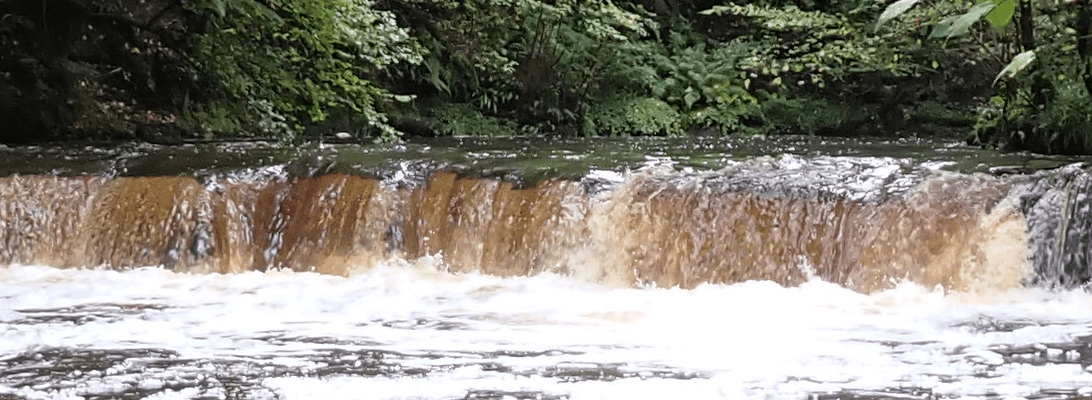
On closer inspection, the color of the river does seem to be a reddish-brown color.
So what is responsible for this color?

It is likely to be a combination of peaty soil and rock type.

Each burn emerges from mires and raised bogs, while the river itself flows through a rocky gorge where there is the presence of ironstone.

On a rainy day, if you look at where waterfalls cascade off the rocks, there is a distinct orange color that indicates ironstone.

So, in conclusion, ironstone combined with the peat that the river flows through gives the river its rusty color.

So now what about the word Calder?

Where does that term originate?

Looking at maps reveals the word Calder is used, not just in Scotland, suggesting that it is not specifically Scottish.
So after much research, I discovered one explanation that seems to make sense. Calder appears to have its roots in very early Brittonic times and means “hard” or “violent.”

When it has been raining for a long time, the surge in water can be powerful enough to carry tree trunks causing damage to bridges and paths.

But is Rusty Coloured Violent water a fitting description for the Rotten Calder Water?

Violent would only describe the river after an exceptional amount of persistent, heavy rain, which would only occur once or twice a year.

In my view, dramatic would be a better word.

It reflects more accurately the condition of the river after there has been some rain when you can hear gurgling and water cading off the rocks.

For me, that is when the river is at its best. It is then that I would recommend that you go for a walk along the Rusty Coloured Dramatic Water.

Looking for a Winter Retreat

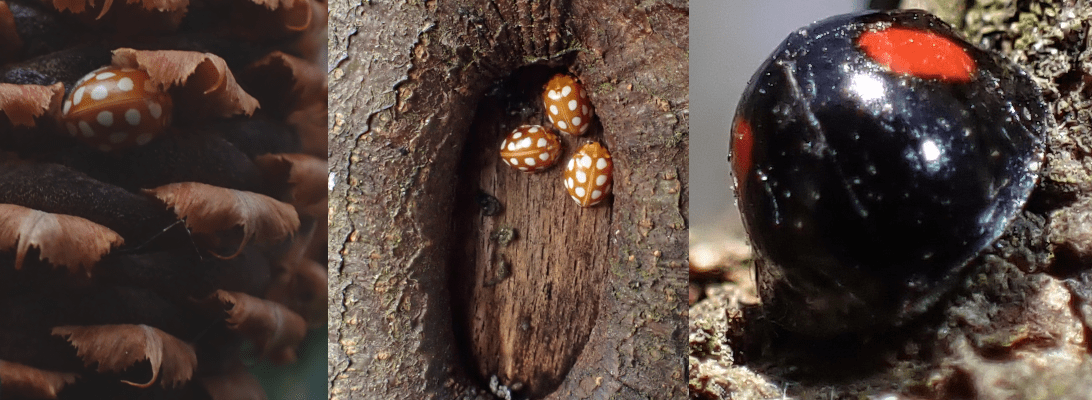
An collage showing three images. the first is n orange ladybird hiding in the scales of a cone. The second is three orange ladybirds overwintering in a tree. the third shows a kidney-spot ladybird.

I found a little orange ladybird, possibly looking for a cozy crevice to spend the winter. It is illustrated below on a type of fir cone. These ladybirds are not often seen. 

Last year I spotted the group illustrated in the middle image huddled on a tree. I am sure they are Orange Ladybirds (Halyzia sedecimguttata). If this is correct, these ladybirds spend most of their time in the leaf canopy, eating mildew and small aphids. That probably explains why I don’t encounter them that often.

This diet of aphids and small insects becomes harder to find during the winter.

So before the weather gets too cold, ladybirds must find a suitable place to spend the winter when they enter a dormant phase. Different species will have their preferred site. Some prefer the crevices found in the bark of a tree, while others find refuge deep in the leaf litter.

I remember visiting a house with a large cluster of ladybirds behind a wooden panel. They had crept in through a crack and, on mass, had decided it was the ideal spot to spend the winter. 

Because of the large number, it did look a bit scary. 

Inside houses are not the ideal place for hibernation. With central heating clicking on, the warmth can wake them up prematurely. Vital energy supplies then get used up in a fruitless search for food. 

 A frost-free garage or shed is a better place for hibernation as the temperature is likely to be constant, and they are less likely to be disturbed. 

I remember it taking a bit of persuasion to reassure the resident that they were not harmful and would disperse in the spring. 

As well as spotting this unusual orange ladybird with cream spots, I have also seen black ladybirds with red splodges on each wing. 

These were at Cathkin Marsh on the Southside of Glasgow. 

There were large numbers of these ladybirds on sallow trees, and had it not been for a more regular visitor pointing them out to me, I would have passed by and not seen them. He explained to me that these were Kidney-Spot Ladybirds (Chilocorus renipustulatus). They get their name from the shape of the splodge on the wing cases.

They are tiny, about 5mm in size, and the other thing to notice is they have a flattened edge that looks a bit like a rim around their wing cases. These ladybirds prefer to overwinter at the base of trees.

Seeing these two ladybirds that are different from the more common red ladybirds with black spots has inspired me to buy a copy of the Field Guide to the Ladybirds of Great Britain and Ireland by Helen Roy and Peter Brown. Next year I am looking forward to finding more Kidney-Spot Ladybirds at Cathkin Marsh and through the autumn will keep an eye out for more hibernating orange ladybirds.

An Orchard for the Community

Apple trees planted several years ago in Calderwood as a Community Orchard have been getting lots of care this year, and I am pleased to say that the work has been worth it. We got a crop of good apples.
Initially, the orchard consisted of four apple trees and two plum trees, but in recent years, they appeared to be drowning in a sea of coarse grasses and were not looking too healthy.
To remedy this, Kirsten, who was initially involved in planting the orchard, decided to give the apple trees a good prune to reinvigorate them.
Then at the turn of the year, a group of us got together to tackle the coarse grass.
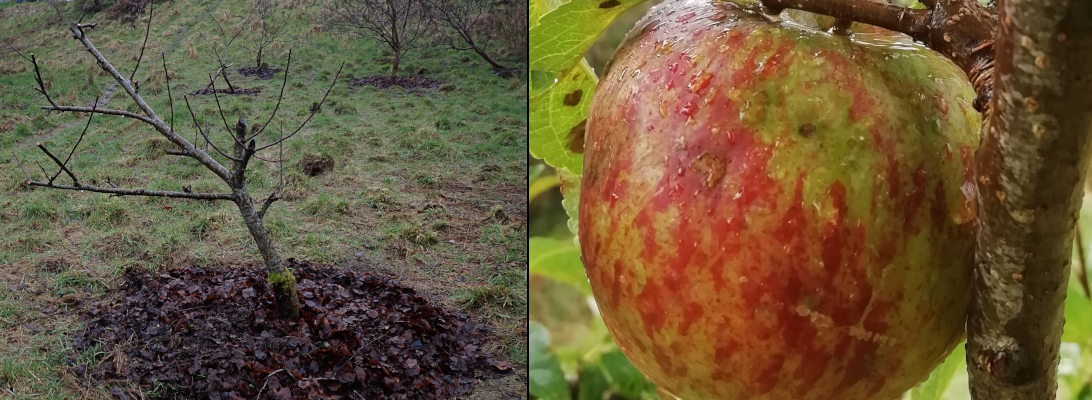
Each tree had the grass surrounding it dug up.
Then, each tree had brown cardboard placed under it.
On top of this was piled lots of leaf mold.
In late winter, there was a donation of four more trees.
After planting, each new tree had more cardboard placed around its base, with leaf litter piled on top.
As winter turned into spring, shoots appeared. Everything was looking good until we experienced acts of vandalism. Not by two-footed humans but by a four-footed variety. A deer was finding the young shoots of the new trees irresistible and using the more established trees as a scratching post.
Fortunately, the deer moved on, possibly as better weather appeared and more people were walking in the area.
When it came time to cut the grass to create walkways through the field, the grass cuttings were placed around each tree, acting as mulch for each tree.
What was interesting was the number of spiders, beetles, and ants that appeared to inhabit the grass around the base.
Hopefully, the orchard will now be more beneficial to people and wildlife.

Overlooked

Local orchids are often attractive with their pretty bright pinks, purples, and even yellows.
But here are two orchids that are not bright and arguably not particularly attractive, making it easy to overlook them.
One is the Broad Leaved Helleborine, a drab-looking plant, mainly green, producing small dark pink/purple flowers.
If you look for it, you can find it in many different places, such as woodlands, hedgerows, and roadsides.
Once you spot it for the first time, you will keep seeing it.
It is now so common around Glasgow that it is called the Glasgow Orchid.
Another drab-looking orchid is the Bird’s Nest Orchid.
The name comes from the tangle of roots that are supposed to resemble a bird’s nest. These roots are necessary, as, unlike most plants, there is no green in the plant’s foliage, so no chlorophyll is present to enable it to make sugars. Instead, it relies on the presence of a particular fungus in the soil for its nutrients. This fungus, in turn, attaches itself to trees such as beech for its nutrients.
Specimens did occur on the South Trail, Calderglen Country Park in East Kilbride. Sadly these have not been seen for some time.
The illustrated specimen above was seen recently in dense woodland in the Calderwood area within the north end of Calderglen Country Park.
Its preference for dense shade and specific growing conditions make the Birds nest Orchid hard to spot, so unlike the Broad Leaved Helleborine, it is rarely seen. Therefore few records exist, suggesting it is rare, but could that be due to under-recording?
So while out exploring, be aware of what you can easily overlook.